
Transit & cargo insurance for Australian businesses
Whether goods are moving around Australia or overseas, the insurance should reflect what is being moved and how the journey is arranged. RMA Insurance Brokers reviews the goods, routes and frequency of transit so the cover suits the way your business operates.
Cover shaped around the goods you move and the way they travel.
Overview
Transit & cargo insurance at a glance
Transit and cargo insurance can protect goods against physical loss or damage while they are being moved by road, rail, sea or air. Cover may be arranged for one shipment or across an annual program for businesses that move goods regularly.
The right arrangement depends on what is being moved, its value, who is responsible for the goods and how the journey is structured. Loading, temporary storage, specialised cargo and international movements can all need closer attention.
Who it is for
Who is this cover for?
Transit and cargo insurance is relevant for businesses that send, receive or move goods, equipment, stock or raw materials, including:
- manufacturers sending finished goods to customers
- wholesalers and distributors moving stock
- retailers receiving goods from suppliers
- primary producers and agribusinesses moving produce or supplies
- importers and exporters
- businesses moving equipment or stock between locations
- businesses relying on regular freight or critical shipments
Cover can be arranged around goods your business owns, purchases, sells or is responsible for. Where goods belong to customers or suppliers, the insurance arrangement should be reviewed specifically rather than assumed to operate in the same way as cover for your own stock.
If your business carries goods belonging to customers for reward, the insurance arrangement may need to address both the goods themselves and your liability as a carrier. RMA Insurance Brokers reviews these exposures separately. See Heavy Motor & Carriers Liability Insurance.
Need cover for a one-off shipment within Australia?
For occasional shipments within Australia, NTI provides an online Shipping & Delivery Insurance facility. Select the banner below to view the available cover and obtain a quote directly through NTI.

You’ll be taken to NTI’s website. Eligibility, terms and policy documentation apply.
Cover
What can it cover?
Transit and cargo insurance can protect goods at different stages of a journey, but the scope of cover depends on the basis selected and the type of movement involved.
The areas below are a guide. Cover, extensions, limits and conditions differ between insurers, so it is worth comparing the options against the goods you move and how they travel.
Australian inland transit
For businesses moving goods within Australia, whether as individual shipments or regular movements. Cover can be arranged around goods travelling by road, rail, air or coastal sea, depending on the policy.
Australian inland + imports & exports
For businesses whose goods move both within Australia and internationally. A combined arrangement can bring Australian inland movements together with import and export cargo, while recognising that overseas shipments can involve different policy clauses, sale terms and responsibilities between buyer and seller.
Loss or damage in transit
Cover can respond to physical loss of or damage to insured goods while they are being moved by road, rail, sea or air.
Some policies provide a broader accidental-damage basis, while others respond only to defined events. The cover basis can materially affect what is automatically included.
Theft & security-related loss
Theft or hijacking-related losses may be covered, subject to the cover basis and any security or documentation conditions that apply.
Not every unexplained shortage or missing item is treated as insured theft. The circumstances of the loss and the evidence available remain important.
Loading, unloading & incidental storage
Loss or damage during loading, unloading or handling can be covered, but whether it is automatically included or needs to be added can depend on the cover basis.
Temporary storage that is a necessary part of the journey may also be included. Longer-term or self-nominated storage generally needs to be reviewed separately.
Imports, exports & international cargo
Cover can be arranged for domestic and international movements, including shipments by sea or air and the inland legs connected with an overseas journey.
International cargo can involve different policy clauses, sale terms and responsibilities between buyer and seller, so the insurance should be aligned with the way each shipment is traded.
Specialised goods & cargo
Temperature-sensitive, high-value or otherwise specialised goods may need to be specifically declared and accepted rather than assumed to be covered automatically.
Live animals and some other specialised cargo can require a different insurance arrangement and should be reviewed separately.
Insured value & cargo limits
The value selected for insurance should reflect the goods being moved and how the policy values them.
Higher shipment values, goods accumulating at one location, or changes in stock and equipment values can all affect whether the limits remain suitable.
Worth checking
What should you review?
A few details make a significant difference when transit and cargo insurance is arranged or reviewed:
the type and value of goods being moved
whether the goods belong to your business or to customers or suppliers
whether cover is needed for one shipment or regular annual movements
domestic routes versus international movements
the transport modes used
loading, unloading and any temporary storage
temperature-sensitive, high-value or other specialised cargo
sale terms, Incoterms or subcontracted transport where relevant
Incoterms® are internationally recognised trade terms published by the International Chamber of Commerce (ICC). They help buyers and sellers understand responsibilities for costs, transport and the point at which risk transfers during an international sale. The chart below provides a useful overview for businesses involved in importing or exporting.
Incoterms can affect which party needs insurance at different stages of a shipment, but they do not determine whether an insurance claim will be paid. The policy wording and who carries the financial risk in the goods remain important.
Imports & exports
Incoterms® responsibilities and transfer of risk
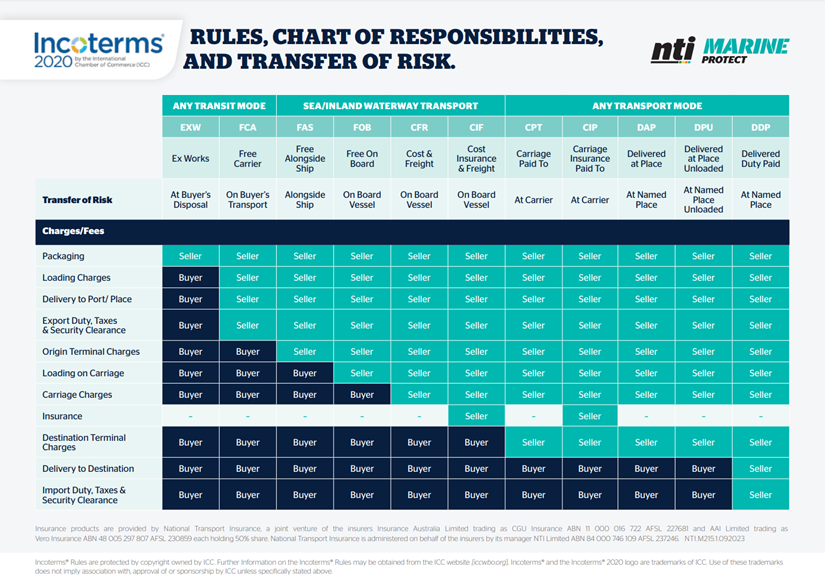
Source: NTI Marine Protect. Incoterms® rules are published by the International Chamber of Commerce (ICC).
Limits
What may not be covered?
Cargo policies do not cover every circumstance. Areas worth checking include:
- wear, gradual deterioration or loss caused by the natural characteristics of the goods
- ordinary leakage or ordinary loss in weight or volume
- inadequate or unsuitable packaging or stowage, depending on who packed the goods and the terms of the policy
- delay or financial loss without insured physical loss or damage
- goods that require specific declaration or insurer acceptance
- storage outside the insured transit arrangement
- movements outside the agreed geographic area, transport mode or policy conditions
- unexplained shortage or disappearance where the policy requires evidence of an insured loss
This is not a complete list. Temperature-controlled goods, hazardous cargo, international movements, high-value goods and other specialised risks can be treated differently between insurers. RMA Insurance Brokers helps explain the areas that need closer review when comparing or arranging cover.
When is it worth reviewing your cover?
It is worth reviewing the insurance when your freight arrangements or the goods you move change, including when:
you begin shipping a new type of goods
the value or volume of goods being moved changes materially
you begin sending goods to new domestic or international markets
your sale terms or Incoterms change responsibility for the goods
you begin carrying goods belonging to customers
you start using new or additional subcontracted transport providers
you begin moving temperature-sensitive or other specialised cargo
one-off shipment needs become regular enough for an annual arrangement
Broker support
Why RMA Insurance Brokers?
Transit and cargo insurance works best when it reflects the way goods move through your business today. RMA Insurance Brokers reviews your current arrangements, explains the options available and identifies areas that need closer attention.
We review insured values, transport and storage arrangements, and whether particular goods or international movements need specific consideration. Where customer-owned goods or a separate carriers liability exposure is involved, we review that separately.
If a claim occurs, we assist with notification, supporting information and communication with the insurer. Photographs, delivery records, invoices, freight documents and retained packaging can also be important after damaged goods are received, and we help clients understand what information is needed.
What happens after you enquire?
We contact you
A broker from RMA Insurance Brokers will contact you to understand the goods being moved, how they travel and the insurance you would like reviewed.
We confirm what is needed
We will explain what information is needed, answer your questions and confirm the next step before approaching insurers.
Useful information to have available
- description and type of goods being moved
- estimated value per shipment
- annual shipment volume or frequency
- origins and destinations, including international movements
- transport modes used
- current policy or schedule, if available
FAQs
What is transit and cargo insurance?
Transit and cargo insurance can cover physical loss of or damage to goods while they are being moved by road, rail, sea or air.
Cover may be arranged for one shipment or across an annual program for businesses that move goods regularly. The cover basis, limits and conditions differ between insurers.
Does transit insurance cover goods carried by a courier or transport company?
It may. If a courier or transport company is moving goods on your behalf, your own transit policy may still cover them where that movement falls within the insured transit.
If your business is carrying goods belonging to customers, that exposure should be reviewed separately rather than assuming ordinary cover for your own goods automatically extends to them.
What is the difference between cargo insurance and carriers liability?
Cargo insurance is arranged around physical loss of or damage to insured goods.
Carriers liability addresses a carrier's legal liability for loss of or damage to a customer's goods. A transport business may need one or both arrangements depending on how it operates and the contracts it enters into.
What is the difference between single-transit and annual cover?
A single-transit arrangement is designed around one particular shipment or movement.
An annual arrangement is generally more suitable for businesses that move goods regularly across the year. The declaration basis, limits and conditions can differ between insurers.
Are goods covered while they are in storage or at a warehouse?
Temporary storage that is a necessary part of the ordinary journey may be included under some transit policies.
Longer-term storage, allocation, distribution or storage arranged separately from the transit can require different cover, so warehouse and storage arrangements should be reviewed specifically.
Explore
Related insurance

Heavy Motor & Carriers Liability Insurance
For transport businesses operating commercial vehicles and carrying customer goods where separate carriers liability exposures need to be considered.

Business Insurance
For stock, property, equipment and other business exposures while goods are not in transit.

Commercial Motor Insurance
For work utes, vans and other commercial vehicles used in business operations.

Liability Insurance
For third-party injury and property-damage exposures arising from business activities.

Trade Credit & Debtors Insurance
For businesses exposed to financial loss when customers cannot pay amounts owed.
Review your transit and cargo insurance
RMA Insurance Brokers reviews the goods you move, how they travel and any current insurance so you can see whether the cover still suits the way your business operates.
The information on this page is general information only and does not take into account your objectives, financial situation or needs. Cover is subject to the terms, conditions, limits and exclusions of the relevant policy. Insurance products and available cover vary between insurers. Please review the relevant policy documentation and obtain advice appropriate to your circumstances before making a decision.